


Ardabil Expo
November 30, 2025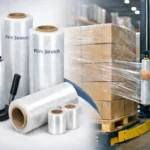
Stretch Film for Pallet Wrapping
February 1, 2026PE Shrink Film: How to Choose the Right Thickness & Width
Choosing the right PE shrink film is not just about asking “how many microns?”.
A film that is too thick, too thin, or poorly matched to the machine can lead to:
tearing during transport
loose corners and ugly wrinkles
higher material consumption and packaging costs
But when the film is engineered correctly, you get:
stronger, safer bundles
cleaner appearance on the shelf
and real savings in material usage.
As an industrial producer of shrink films, we work with customized blends of LDPE and LLDPE to match different packaging lines and product weights — especially in beverage, food and general industrial packaging.
1. What determines the right shrink film?
Before choosing the thickness or width, consider these four factors:
1️⃣ Final bundle weight
Heavier packs require:
higher tear resistance
stronger shrink force
reinforced corners
2️⃣ Type of application
PE shrink film is commonly used for:
multipack bottled water and soft drinks
canned products
shrink over cartons
light industrial parts
pallet protection (shrink hood)
Each application has different technical requirements.
3️⃣ Transport & storage conditions
Export shipments, heat, vibration and repeated handling require more robust film — not necessarily thicker, but better engineered.
4️⃣ Shrink tunnel capability
Older tunnels vs. modern multi-zone tunnels perform differently.
Thicker films need:
higher temperature
or more time inside the tunnel
2. Practical thickness guide (microns)
Typical working range for PE shrink films:
30–100 microns, depending on product type.
| Application | Typical Weight | Suggested Thickness |
|---|---|---|
| Small lightweight multipacks | up to ~3 kg | 30–40 μm |
| Bottled water / soft drinks | 6–20 kg | 40–60 μm |
| Cans & beverages | 5–18 kg | 40–60 (up to 70) μm |
| Shrink over cartons | 10–30 kg | 50–70 μm |
| Heavy cartons | 20–40 kg | 60–80 μm |
| Very heavy / pallet hood | 40+ kg | 80–120 μm |
Use this table as a starting point. Final approval should always be done by testing on the actual line.
3. Thicker doesn’t always mean stronger
Many buyers think:
“Thicker = better”
In reality, with the right blend of LDPE + LLDPE:
✔ equal strength
✔ better puncture resistance
✔ less material
can often be achieved at lower thickness.
This is where engineered formulations make a real difference — especially when material saving is a priority.
4. Choosing the correct film width
For center-fold (half-tube) film, a simple starting rule:
**Flat width ≈ (perimeter of the pack + height) ÷ 2
5–10% allowance**
More allowance for sharper edges, dense packs or high shrink tension.
Wrong width means:
tearing
wrinkles
wasted material
5. “Comparing suppliers” is not enough
Many buyers search for:
shrink film manufacturers
PE shrink film suppliers
buy shrink film directly from factory
Comparing prices helps —
but quality depends on far more than price:
resin quality
LDPE/LLDPE ratios
process control
consistency
technical support before production
A tailored formulation, tested on your machine, always performs better than a generic product.
6. Checklist before ordering
Answer these questions and you will choose correctly:
1️⃣ Final bundle weight
2️⃣ Number of units per pack
3️⃣ Transport conditions (local / export)
4️⃣ Tunnel type and limitations
5️⃣ Required appearance (clarity / print)
6️⃣ Goal: durability or material reduction?
With this information, the right PE shrink film can be engineered for your line.
Conclusion
PE shrink film, when correctly designed, delivers:
safer packaging
cost optimization
better visual appeal
Using engineered LDPE/LLDPE blends allows you to reduce thickness without compromising strength — and ensures stable performance on the line.
